World and Actors
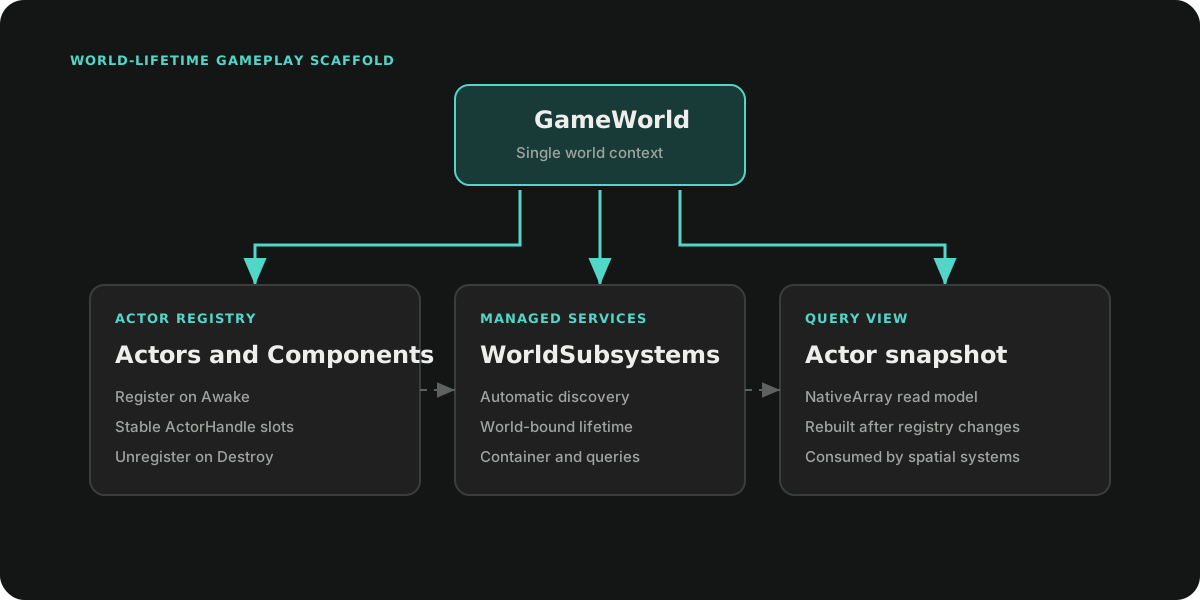
The Gameplay world is a scene-level ownership boundary. GameWorld tracks Actors and owns WorldSubsystem instances; WorldContext and versioned handles provide safe access without turning every service into a process-wide singleton.
Create a world subsystem
Apply [InitializeOnWorldCreate] when a subsystem must exist for every world. Ceres constructs it, calls Initialize, ticks it with the world, and calls Release when the world is destroyed.
using Ceres.Gameplay;

[InitializeOnWorldCreate]
public sealed class ScoreSubsystem : WorldSubsystem
{
    public int Score { get; private set; }

    protected override void Initialize()
    {
        Score = 0;
    }

    public void AddScore(int value)
    {
        Score += value;
    }

    protected override void Release()
    {
        Score = 0;
    }
}
Retrieve it through a valid WorldContext.
WorldContext world = GameWorld.Get();
ScoreSubsystem scores = world.GetSubsystem<ScoreSubsystem>();
scores.AddScore(100);
Use WorldSubsystem.GetOrCreate<T>() for an optional subsystem that should be created on first use instead of world creation. Override CanCreate(WorldContext) when availability depends on the current world.
Actors and components
Actor is a FlowGraphObject placed on a GameObject. It registers with the current world in Awake and unregisters in OnDestroy. An ActorComponent must share that GameObject; it registers itself with the Actor during its own Awake.
using Ceres.Gameplay;
using UnityEngine;

public sealed class EnemyActor : Actor
{
}

public sealed class HealthComponent : ActorComponent
{
    [field: SerializeField]
    public int Current { get; private set; } = 100;

    public void ApplyDamage(int amount)
    {
        Current = Mathf.Max(0, Current - amount);
    }
}
Resolve a component from its Actor without a scene-wide component search.
HealthComponent health = enemy.GetActorComponent<HealthComponent>();
health.ApplyDamage(10);
PlayerController is an Actor that can possess one other Actor through SetActor. The controlled Actor exposes that relationship through GetController() or GetTController<T>().
Actor handles
Store an ActorHandle when another system needs a non-owning reference, then resolve it through the world at the point of use.
ActorHandle handle = enemy.GetActorHandle();

Actor current = GameWorld.Get().GetActor(handle);
if (current != null)
{
    // The same Actor version is still registered.
}
After an Actor leaves the world, its old handle no longer resolves even if the sparse slot is reused.
World services
ContainerSubsystem is created with every world and stores services for that world lifetime.
public sealed class CombatRules
{
}

public static class WorldServices
{
    public static CombatRules RegisterRules()
    {
        IContainerSubsystem container = ContainerSubsystem.Get();
        container.Register(new CombatRules());
        return container.Resolve<CombatRules>();
    }
}
Registrations and registration callbacks are cleared when the world is released. A registration callback has world lifetime and has no individual unregister API.
Actor query snapshots
ActorQuerySystem maintains native actor data for spatial and job-based queries. GetAllActors returns a copied snapshot owned by the caller.
using Ceres.Gameplay;
using Unity.Collections;

ActorQuerySystem query = WorldSubsystem.GetOrCreate<ActorQuerySystem>();
using NativeArray<ActorData> actors = query.GetAllActors(Allocator.Temp);

foreach (ActorData actor in actors)
{
    if (actor.Active)
    {
        // Read actor.Handle, actor.Position, actor.Rotation, and actor.Layer.
    }
}
Positions, rotations, and active state are refreshed during the subsystem tick. Layer values are refreshed when the Actor set is rebuilt.
Lifecycle and constraints
GameWorld.Get()returns the current world or creates one when access is safe. If a scene already contains aGameWorld, that instance becomes current; duplicate worlds are destroyed.- Retained
WorldContextvalues must be checked withIsValid()before use.Cast()asserts when the world is no longer valid. - Auto-created subsystems must have a parameterless constructor. Their lifetime ends with the world.
- Runtime-created subsystems join ticking after the world rebuilds its subsystem snapshot.
- Actors register in
Awake; do not expect a valid handle from an earlier Unity callback. - A query snapshot is independent native memory and must be disposed by its caller.
Related documentation
- Actor Flow for graph-backed Actor behavior
- Level for world lifetime across scene transitions
- Collections for the sparse storage behind Actor handles
- AI and Spatial Queries for consumers of actor query snapshots