Ceres Architecture and Concepts
Ceres is a unified Unity framework that spans reusable runtime services, graph and visual scripting infrastructure, and gameplay systems. The package is organized into Core, Graph, Flow, and Gameplay layers.
Framework Layers
| Layer | Assembly | Responsibility |
|---|---|---|
| Core | Ceres |
Events, scheduling, configuration, serialization, resources, data, content, pooling, tasks, and modules |
| Graph | Ceres.Graph |
Nodes, ports, variables, graph data, serialization, and editor-independent graph behavior |
| Flow | Ceres.Flow |
Event-driven execution, C# API exposure, debugging, hot reload, and generated runtime programs |
| Gameplay | Ceres.Gameplay |
Actor-based worlds, levels, animation, presentation, spatial queries, runtime content, and Flow integration |
Dependencies point in one direction:
Ceres → Ceres.Graph → Ceres.Flow → Ceres.Gameplay
Use the lowest layer that owns the capability you need. Core services do not depend on gameplay code, while Gameplay may expose its APIs to Flow.
Core Services
Ceres Core provides the application-level building blocks shared by the rest of the framework. Start with Events, Schedulers, Configs, Serialization, Resource, Data Driven, Content Pipeline, Collections, Reactive Integration, Pool, Tasks, and Modules.
Graph Concepts
Node
CeresNode is the logic and data container that forms a graph.
Port
CeresPort enables you to get data from other nodes.
Ceres uses CeresPort<T> to receive typed data from another node. NodePort stores a NodeReference that can be resolved to a CeresNode at runtime.
Graph
CeresGraph owns the nodes, variables, and connections and acts as the graph runtime.
Data
Ceres serializes nodes, ports, and graphs into CeresNodeData, CeresPortData, and CeresGraphData, which contain the persisted data and metadata.
Variable
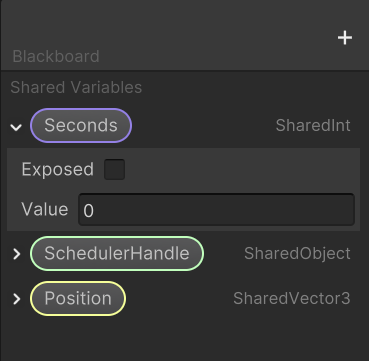
SharedVariable is a data container that can be shared between nodes and graphs.
Unlike a CeresPort, a SharedVariable can be edited outside the graph and does not contain connection data because it does not need to know where its value originates.
Execution Path
Nodes can be executed in two ways:
Forward: the graph executes nodes in sequence.
Dependency: the graph evaluates a node's data dependencies before executing that node.
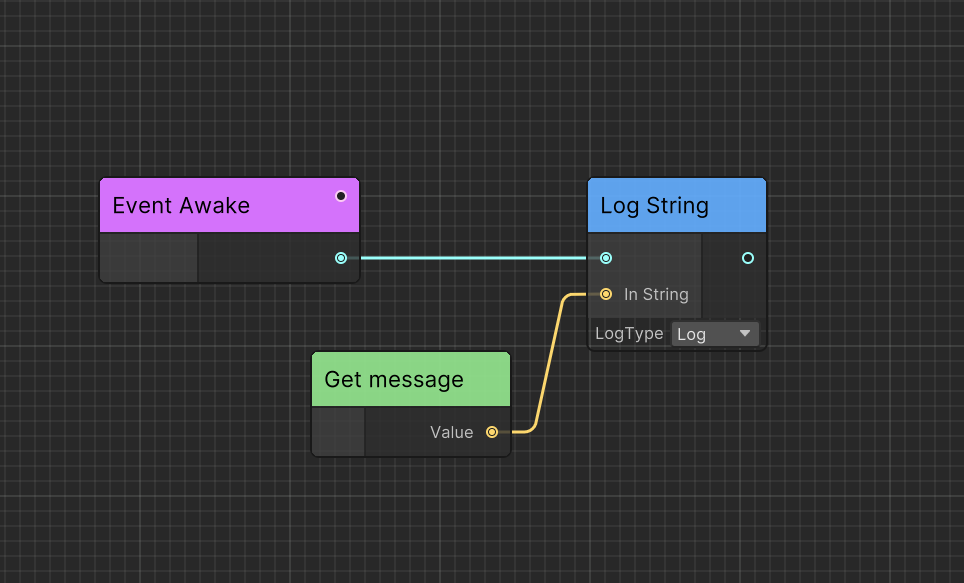
In the example, Log String needs the message value. Because Get message is not part of the forward execution path, the graph treats it as a dependency and evaluates it before Log String.
Flow and Gameplay
Ceres Flow adds event-driven execution and exposes C# events and functions as strongly typed nodes. Ceres Gameplay builds on Core, Graph, and Flow to provide higher-level game architecture and ready-to-use systems.
Related guides
- Follow the Flow Quick Startup to create a visual script.
- Read Gameplay to build on GameWorld, Actor, and the gameplay modules.
- Explore Code Generation to understand Ceres source generation.