Events
Ceres Events provides pooled event objects, callback routing, contextual propagation, frame-bound dispatch, and Editor tracing. Use EventSystem for application-wide messages and CallbackEventHandler hierarchies when an event needs a target and propagation path.
Define and send an event
Declare a non-generic partial event with public readable properties. Ceres.Events.SourceGenerator generates Create(...), obtains a pooled instance, and assigns those properties.
using Ceres.Events;

public partial class DamageEvent : EventBase<DamageEvent>
{
    public int Amount { get; private set; }
}
Register the callback while its owner is active, then unregister the same delegate when that lifetime ends.
using Ceres.Events;
using UnityEngine;

public sealed class DamageListener : MonoBehaviour
{
    private void OnEnable()
    {
        EventSystem.RegisterCallback<DamageEvent>(OnDamage);
    }

    private void Start()
    {
        using var evt = DamageEvent.Create(12);
        EventSystem.SendEvent(evt);
    }

    private void OnDisable()
    {
        EventSystem.UnregisterCallback<DamageEvent>(OnDamage);
    }

    private static void OnDamage(DamageEvent evt)
    {
        Debug.Log($"Damage: {evt.Amount}");
    }
}
EventSystem.SendEvent queues the event for Update by default. Select FixedUpdate or LateUpdate with MonoDispatchType, or use DispatchMode.Immediate when dispatch must finish inside the current call.
using var evt = DamageEvent.Create(12);
EventSystem.SendEvent(
    evt,
    DispatchMode.Default,
    MonoDispatchType.LateUpdate);
Contextual propagation
CallbackEventHandler can form a hierarchy through its Parent property. An event with TricklesDown or Bubbles enabled travels through that hierarchy around its target. Register a callback with TrickleDown.TrickleDown to receive the descending phase; the default registration receives the target or bubble phase.
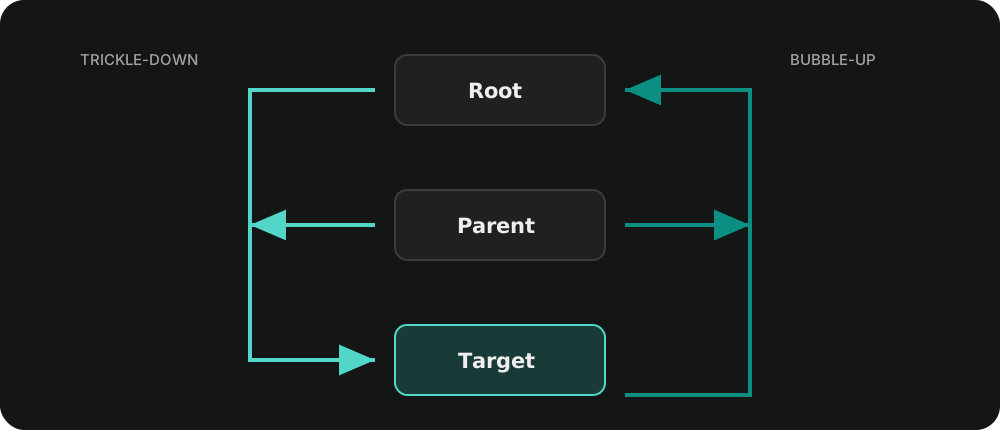
During a callback, use StopPropagation, StopImmediatePropagation, or PreventDefault only when the handler owns that routing decision. Application-wide events usually do not need a custom hierarchy.
Lifetime and ownership
- Event instances are pooled. Create them through generated
Create(...)orGetPooled(), and dispose the caller's reference withusing. - Queued dispatch acquires its own reference, so disposing the caller's reference after
SendEventis safe. - Do not retain an event instance after its dispatch or disposal. Copy the values that must outlive the callback.
- If an event supplies a custom static
Createmethod, the generator leaves it unchanged.
Event Debugger
Open Tools > Ceres > Debug > Event Debugger while the application is playing. The debugger can inspect coordinators, registered callbacks, propagation paths, callback timing, and default actions. It can also record, save, load, and replay selected events.
Debugger recording is an Editor diagnostic path, not a runtime persistence API.
Related documentation
- Schedulers for time- and frame-based callbacks
- Tasks for prerequisite-driven work and completion events
- Reactive Integration for exposing callback handlers as R3 observables